Rounding Bottompattern.
A long, broad base on the higher timeframe in which price repairs slowly before expanding. In the book’s framework it is defined by duration: shorter rounded bases are treated as Curve patterns instead.
- A higher-timeframe, multi-year structure.
- Defined by duration, not just shape.
- Decision level is a long-term resistance.
- Book includes no separate Rounding Top.
Idealised outline. The dashed yellow line is the support or resistance the book asks you to draw before naming the pattern.
How the book reads it
- 01
Structure — how to draw it
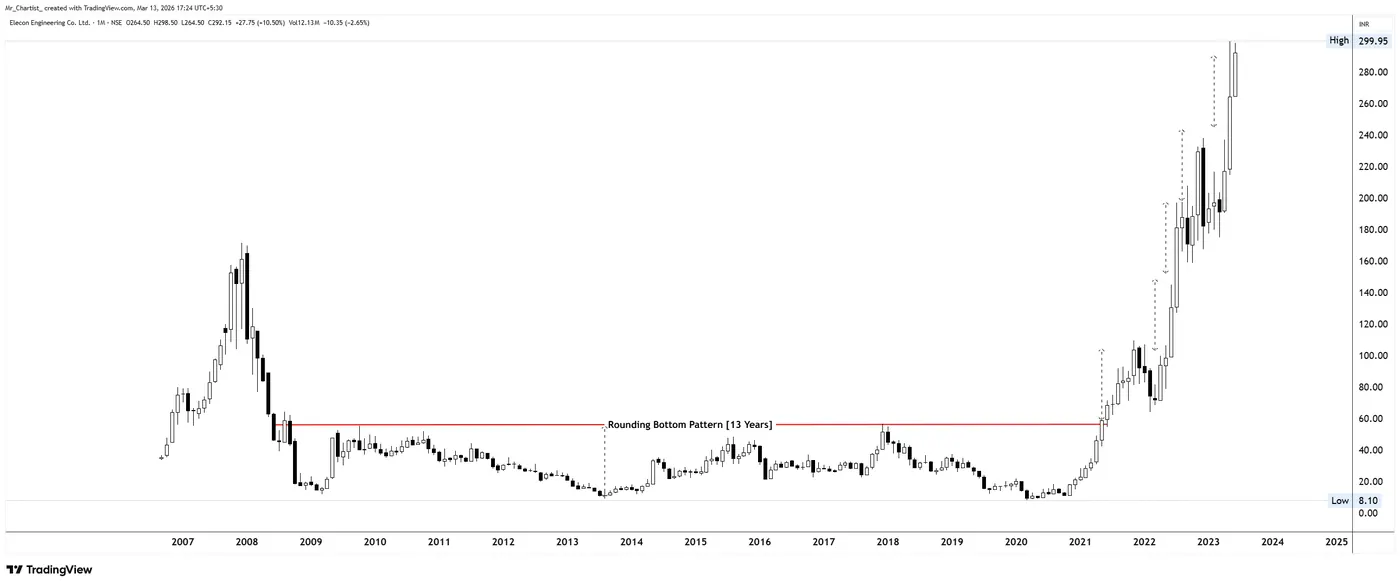
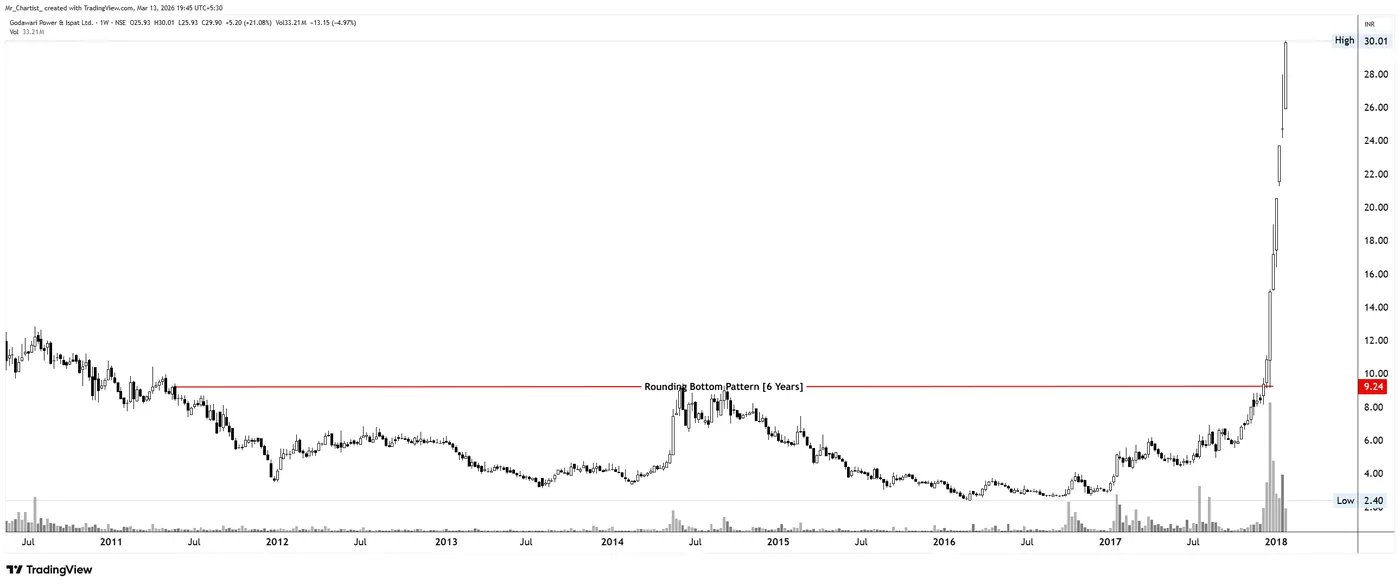
Look for a smooth, extended curve on the monthly chart that develops over several years, together with a clear long-term decision level, usually an old resistance formed before the base began.
- 02
Psychology — who is in control
Weak hands exit, public interest fades and volatility contracts while stronger participants accumulate without urgency. Dips grow shallower and recoveries hold better, showing stability rather than excitement.
- 03
Confirmation
The book requires a decisive close above the long-term decision level, visible on the higher timeframe and supported by expanding volume. A retest that holds the old resistance as support adds confidence.
- 04
Risk — where the idea is wrong
The book frames this as a position-management structure with wide, structure-based risk, using a mid-pattern reference. The measured move is treated as a milestone rather than a final objective, with exits led by structure.
- 05
Common trap
Treating it like a short-term setup, with tight stops and quick exits, is the mistake the book highlights. Calling a short rounded move a Rounding Bottom is another; the book reserves the name for multi-year bases.
On real charts
Annotated by Mr. Chartist for the book: the structure, the breakout, the pattern's height and the level that proves the idea wrong. Historical charts for education — not a view on any stock today.
More curved patterns
Gradual structures where control transfers over many candles before a decisive move develops.
From the book · Curved support & resistance
The full Rounding Bottom chapter — in the book.
Development stages, volume behaviour, breakout quality, traps and more annotated case studies.