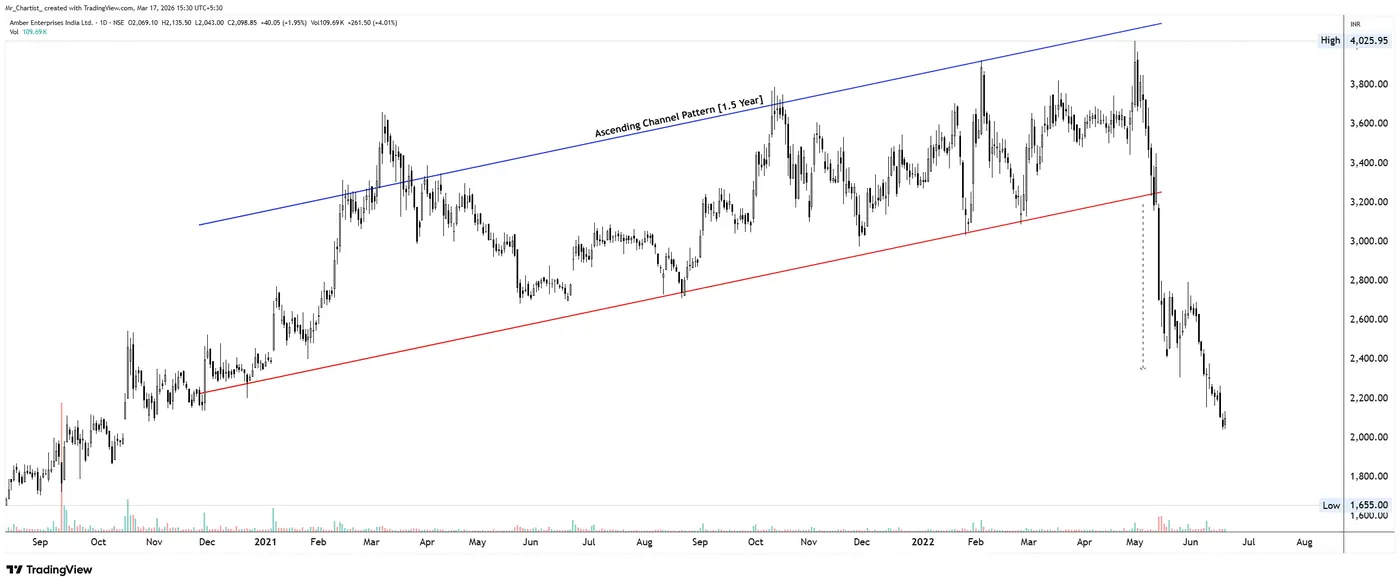
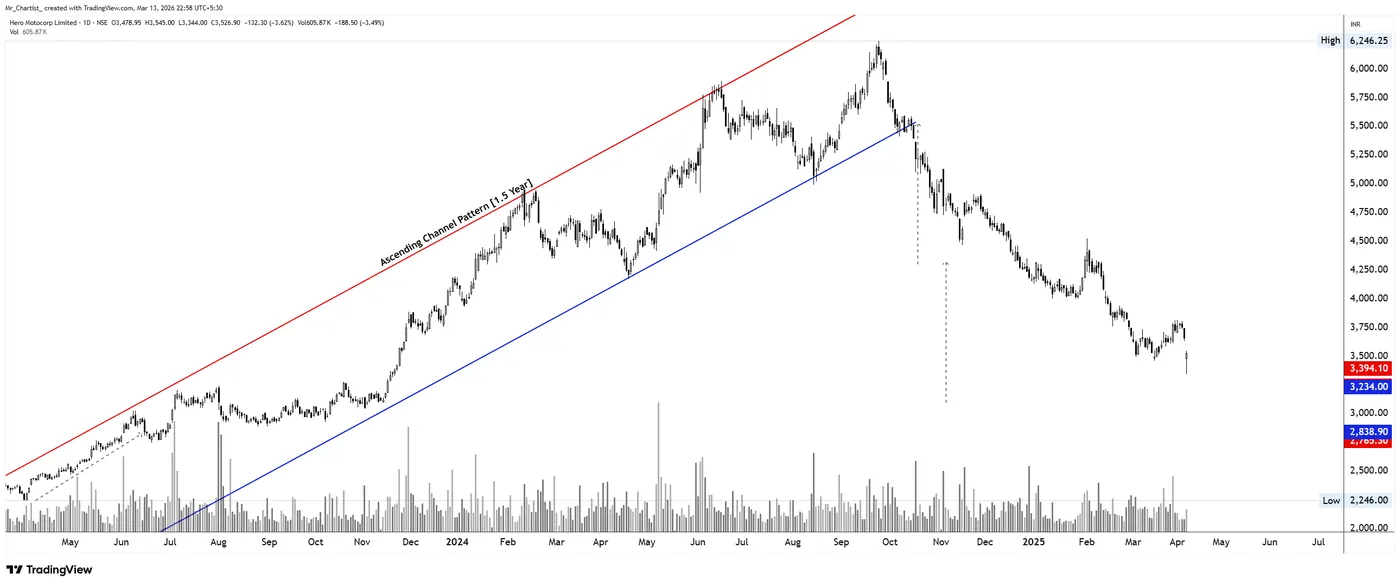
Ascending Channelpattern.
An orderly rise between two parallel rising trendlines that looks healthy on the surface. The book argues it often reflects controlled distribution, so it can carry a bearish bias when the rise lacks expansion.
- Looks bullish, often behaves as distribution.
- Context: after a rally or as a rise inside a downtrend.
- Watch for rallies losing momentum near the top.
- Lower-line break with a decisive close confirms.
Idealised outline. The dashed yellow line is the support or resistance the book asks you to draw before naming the pattern.
How the book reads it
- 01
Structure — how to draw it
Connect the rising swing lows for support and the rising swing highs for resistance, keeping the lines parallel. Look for several clean touches on both lines; the book expects the channel to develop gradually, not impulsively.
- 02
Psychology — who is in control
Late buyers keep entering near rising support, believing the trend is intact, while earlier participants distribute patiently near the top. The rise persists because selling is measured, not because buying is expanding.
- 03
Confirmation
The book treats a decisive close below the lower channel line, ideally with expansion in range or volume, as the signal that the structure has failed. A failed retest of that line from below adds confirmation.
- 04
Risk — where the idea is wrong
The book places invalidation above the last swing high inside the channel. It uses the channel’s height projected from the breakdown as a first reference, and the zone where the channel began as a structural reference.
- 05
Common trap
The main trap is assuming every pullback to support is an opportunity to join the uptrend. Single wicks below support, or a quick reclaim back inside the channel, do not count as confirmation.
On real charts
Annotated by Mr. Chartist for the book: the structure, the breakout, the pattern's height and the level that proves the idea wrong. Historical charts for education — not a view on any stock today.
More diagonal patterns
Rising or falling boundaries that reveal changing momentum, participation, pressure, and direction.
From the book · Diagonal support & resistance
The full Ascending Channel chapter — in the book.
Development stages, volume behaviour, breakout quality, traps and more annotated case studies.